How Interior Designers and Commercial Specifiers Get Custom Wallpaper Right First Time

Specifying custom wallpaper for a commercial project isn't the same as choosing one for a living room. The decisions run deeper, the stakeholders multiply, and the margin for error shrinks considerably. This guide walks through the specification process from wall measurement to installation planning - so the finishing result looks exactly as intended.
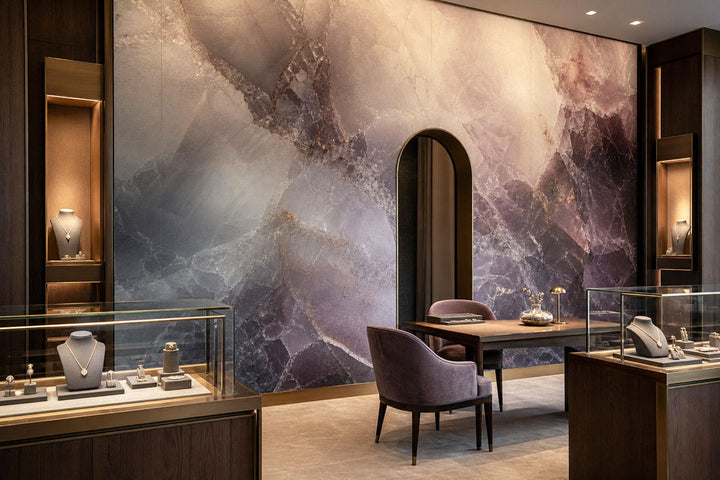
Custom wallpaper murals translate a chosen design into a precisely scaled, panel-printed wall covering built to the exact dimensions of a specific wall. The process runs from measurement through design approval and print production to delivery - no standard sizes, no closest-fit compromises. Done correctly, the wall looks considered rather than decorated.
Key Takeaways
• Wall measurement is the starting point - every downstream decision depends on getting it precisely right
• Paper type is a functional specification, not a finishing touch; the substrate must match the environment
• Commercial projects involve fire ratings, durability standards, and multi-stakeholder approval that residential projects don't
• The wall specification framework - Surface, Environment, Audience, Longevity - prevents the most common and costly briefing errors
• Custom wallpaper isn't right for every project; knowing when it isn't the answer is as important as knowing when it is
Why Do So Many Commercial Walls End Up Feeling Like an Afterthought?
It's not a question of budget or ambition. In most commercial fit-outs, the wall loses because it gets briefed last.
Flooring gets specified early because it affects everything above it. Lighting follows. Furniture, joinery, and soft furnishings fill in the gaps. Then, somewhere near the end of the programme, someone looks at the walls and realises they're carrying the most visual weight in the room and nobody's given them a job to do yet. At that point, the contingency budget is gone and the timeline is tight.
The wall doesn't fail because of taste. It fails because of process.
This is the pattern Wallpapered exists to interrupt - not just by printing wallpaper, but by giving specifiers a clear decision sequence that brings the wall into the brief at the right moment, not the last one.
What Does the Specification Process Actually Look Like?
Most people assume it starts with choosing a design. It doesn't.
It starts with the wall itself. Measuring your wall accurately is the first step - and the one that determines everything that follows. Width and height at their widest and tallest points, plus the position and dimensions of any architectural interruptions: doors, windows, sockets, recesses. A mural printed to the wrong dimensions can't be trimmed to fit without losing the design's composition. The measurement isn't a formality; it's the foundation the entire project is built on.
Once dimensions are confirmed, design selection and customisation happen in parallel. Wallpapered's curated catalogue spans botanical, architectural, photographic, abstract, and typographic styles - each scalable, croppable, and colour-adjustable to fit the specific wall. Custom map wallpaper, one of the most frequently requested applications for commercial and estate agency projects, follows the same logic: the map is built around the wall, not squeezed into a standard format.
After design sign-off, the file goes to print. Panels are produced to the exact wall dimensions, numbered in installation sequence, and shipped with free delivery across the UK and Europe. We also ship worldwide, with extensive experience supplying bespoke wallpaper murals for international interior projects.
Does Paper Type Really Make That Much Difference?
Yes. And it's consistently the decision that gets underestimated until something goes wrong.
Paper type is a functional specification. The substrate affects durability, washability, finish texture, and how the print holds up in different environments. A gym wall needs something fundamentally different from a hotel bedroom. A school corridor makes demands that a restaurant feature wall doesn't.
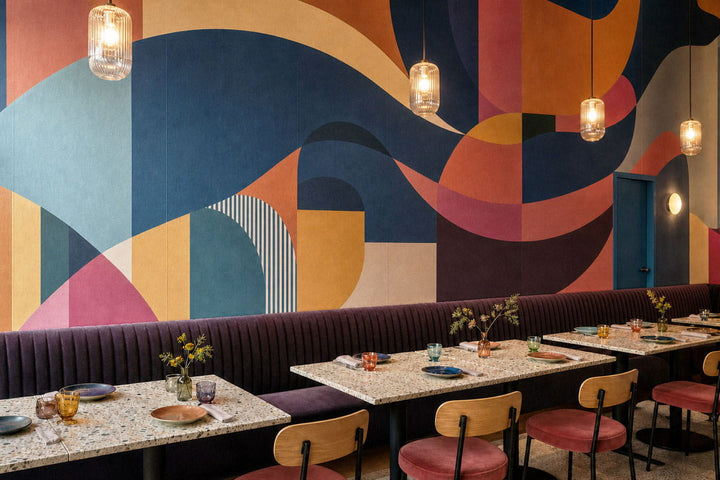
Consider a typical scenario: a restaurant specifies a large-format botanical mural for the wall behind the bar. The surface faces direct lighting, occasional moisture from the bar environment, and regular cleaning. A standard residential paper degrades within months under those conditions. A commercial-grade vinyl with a satin finish holds the print quality and wipes clean. Same design file, very different outcome - because the substrate was matched to the environment rather than chosen by appearance alone.
Wallpapered offers a range of paper types across residential and commercial grades. The choice between a standard wallpaper, a commercial vinyl, or a specialist textured finish isn't a preference decision - it's a specification decision, and it needs to be made before production, not revised after installation.

How Is a Commercial Project Different From a Residential One?
The design conversation looks similar. The specification process is entirely different.
Commercial installations - hotels, offices, schools, gyms, retail spaces - carry requirements that residential projects don't. Fire ratings. Durability standards. Installation access windows fixed around business hours. And often, multiple stakeholders who all need to approve the design before production can begin. A homeowner can make a decision in an afternoon. A hotel refurbishment might involve a procurement manager, a brand standards document, and a facilities director who needs to confirm the installation method won't affect the substrate.
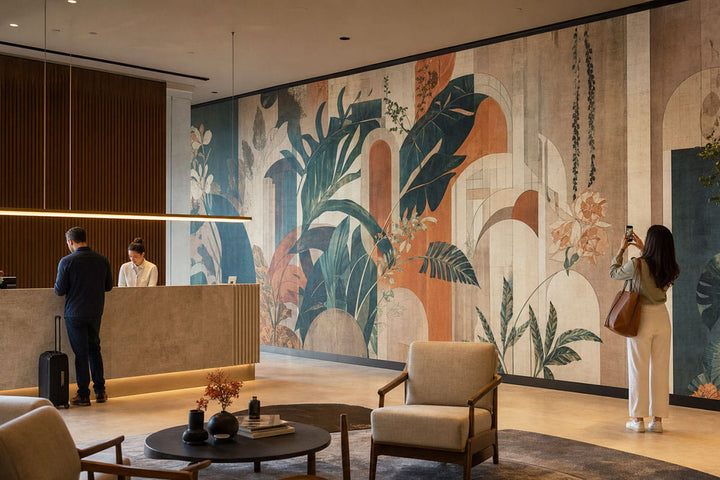
Wallpapered's commercial wallpaper service is built around this reality. Our company works directly with interior designers, commercial fit-out teams, and property managers across hotels and resorts, corporate offices, restaurants and cafes, schools and universities, and retail spaces.
The distinction that matters most in commercial work: a mural isn't decoration. It's a brand asset. When a hotel commissions a custom map for its lobby, or a corporate office installs a large-format cityscape behind reception, the wall is communicating something specific about the organisation. That requires a different level of design intent - and a different level of specification rigour - than selecting a pattern because it looks right.
If you're specifying wallpaper for a commercial project, Wallpapered's trade and interior designer service is worth reviewing before you brief the project. It covers how the process works for designers specifying on behalf of commercial clients, including lead times, sample availability, and print quality standards.
The Wall Specification Framework: Four Variables That Prevent Expensive Mistakes
The Wall Specification Framework is a four-variable decision sequence used to align design intent with physical reality before any print file is produced. It's useful when you're specifying a custom mural for a new project - commercial or residential - and haven't yet confirmed all four variables. If you're reordering for an existing wall, the specification is already done.
The four variables are:
Surface - wall dimensions, substrate condition, architectural interruptions
Environment - humidity levels, light exposure, footfall and impact, cleaning frequency
Audience - who occupies the space, and what the wall needs to communicate to them
Longevity - how long the installation needs to perform before the next planned refresh
Every decision about design, paper type, and installation method flows from these four. Miss one and you're guessing at something that will affect the finished result. Get all four right and the brief practically writes itself.
This framework maps directly onto how installation planning works in practice - installation method, paste type, and panel sequencing all depend on variables established at this stage, not improvised on the day.
Custom Wallpaper vs. the Alternatives: A Specification Comparison
|
Approach |
Customisation |
Scale to wall |
Commercial grade |
Lead time |
Best suited for |
|
Custom wallpaper mural |
Full |
Exact |
Yes (vinyl) |
Days |
Permanent or long-term installations |
|
Standard wallpaper |
Pattern only |
Fixed repeat |
Limited |
Immediate |
Residential, low-specification commercial |
|
Paint |
Colour only |
Full wall |
Yes |
Immediate |
Backgrounds, quick turnarounds |
|
Framed artwork |
Full |
Limited |
Yes |
Variable |
Focal points within a larger scheme |
|
Peel-and-stick wallpaper |
Full |
Adjustable |
Limited |
Days |
Temporary installs, rental properties |
The honest tradeoff with custom wallpaper: it requires more upfront decision-making than any of the alternatives. There's no shelf to browse, no impulse purchase. The process needs a measurement, a brief, and an approval stage before production begins. For projects with undefined briefs or changing wall dimensions, that friction is real.
Custom wallpaper is not a fast solution. It's a considered one - and that's exactly why the result reads differently from everything else in the room.
When Is Custom Wallpaper Not the Right Answer?
Some projects genuinely aren't a good fit, and it's worth being direct about that.
If your installation date is tomorrow, custom print production won't meet it. If the wall dimensions change regularly - a temporary exhibition space, a pop-up retail unit with a three-month tenure - the investment in a precision-printed mural doesn't stack up. If the brief is genuinely undefined and the client hasn't committed to a direction, starting the print process early creates expensive reprints.
For temporary installations or rental properties where permanent adhesive isn't viable, removable peel-and-stick wallpaper is a sensible alternative - everything you need to know about peel-and-stick options covers the practical considerations if that's your situation.
The projects where custom murals consistently deliver the strongest results: permanent or long-term installations where the wall is a considered part of the design from the outset, not something addressed after everything else is in place.
FAQ
How long does it take to receive a custom wallpaper mural after ordering?
Wallpapered typically produces and ships orders within a few working days, with free delivery across the UK and Europe. The typical lead time for delivery is 7-10 working days. For commercial projects with fixed installation dates, confirm your timeline directly with the team before placing the order.
Can I supply my own artwork or photography for a custom mural?
Yes. Wallpapered works with client-supplied images, brand photography, and existing design assets. File resolution is the critical variable - the image needs sufficient quality to print at wall dimensions without visible pixelation. The team will assess whether a supplied file meets the print specification before the order is confirmed.
How should I measure my wall before starting the specification?
Take width and height at their maximum points, and note the position and dimensions of any architectural features - doors, windows, sockets, or alcoves. These affect how the design is composed across the panels. Wallpapered's wall measurement guide walks through the full process.
Does custom wallpaper hold up in high-traffic environments like gym floors or school corridors?
It does, provided the paper type is specified correctly. Standard residential wallpapers aren't built for heavy cleaning, impact, or sustained footfall. Commercial-grade substrates are available for exactly these environments. The substrate specification is part of the brief - not something to address after the print file is approved.
How is installation planned for a large commercial project?
Panels are numbered in installation sequence, and the method - paste-the-wall or paste-the-paper - varies by substrate. For large-scale commercial installations, professional installation is strongly recommended. Wallpapered's installation guidance covers the process in detail, including preparation, panel alignment, and finishing.
Can estate agents use custom murals for property staging?
Yes, and it's one of the more effective staging tools for properties where the brief is to create a strong first impression in photography. A well-chosen feature wall transforms a neutral room into something memorable in listing images - which is where most property decisions now begin. Wallpapered works directly with estate agents on staging and office fit-out projects, including custom map wallpaper for agency reception and client-facing spaces.
Is there a minimum order size for commercial projects?
There's no minimum panel count or fixed format imposed by the production process. Whether it's a single feature wall in a boutique hotel room or a corridor installation across multiple floors, the order is sized to the project. For large-scale or multi-site commercial enquiries, contacting the team directly is the most efficient starting point.
The wall that's doing nothing isn't waiting for a trend to make it relevant. It's waiting for a brief. Give it one - and the room changes around it.
If you're ready to specify, start with the commercial wallpaper service or get in touch with the Wallpapered team to talk through your project.