Commercial Wallpaper Specification Guide for Interior Designers and Fit-Out Teams

Specifying custom printed wallpaper for a commercial project requires a fundamentally different approach than selecting a pattern design for a residential room. The substrate, the wall conditions, the brief, and the brand logic all need to be resolved before anything goes to print. Get that sequence right, and the wall earns its place in the room. Get it wrong, and a costly reprint is the least of your problems.
Key Takeaways
• Treat the wall as a primary design decision, not a finishing one - environment, dimensions, and design intent must all be resolved before substrate selection.
• Substrate choice in commercial settings isn't aesthetic; it's functional - the wrong finish in a high-traffic environment will show wear far sooner than expected.
• Measurement errors are among the most common and most expensive failures in custom wallpaper projects - every wall needs to be measured independently.
• Commercial sectors each carry distinct specification requirements; a supplier experienced only in residential work will miss the environmental and brand demands of a hotel, gym, or school.
• Custom printed wallpaper isn't the right answer for every wall - knowing when not to use it is part of sound specification practice.
Why Do Commercial Wallpaper Projects So Often Fall Short?
The failure rarely happens in the print room.
Large-format digital printing has reached a genuinely high standard - colour accuracy, resolution, and detail reproduction have all improved significantly over the past decade. When projects disappoint, the problem almost always sits earlier: vague dimensions passed to the printer, a substrate chosen for visual appeal rather than environmental suitability, or a design concept developed in isolation from the architecture it's supposed to respond to.
In my experience specifying custom wall solutions across commercial sectors, the pattern is consistent. A gym wall is a different problem from a hotel corridor. A school reception has different abrasion and moisture demands than a corporate boardroom. Treating each as the same specification challenge is where things start to unravel - and where reprint costs and delayed timelines find their way into a project budget.
There's also a conceptual error that runs through a lot of these briefs. Many buyers still think of custom printed wallpaper as a superior version of standard wallpaper - a better image, printed to size. It's a different category of product with a different design logic, different installation requirements, and a different relationship to the space around it. That misunderstanding drives most of the underperformance.
What Does a Reliable Specification Process Actually Look Like?
The most dependable approach follows what I'd call a Wall-First Sequence - a four-stage structure that treats the wall as a structural element rather than decoration applied at the end.
Stage 1 - Environment audit. Before any design work begins, establish what the wall is actually dealing with: humidity levels, light exposure, surface material, and daily traffic. These factors determine substrate selection before aesthetics enter the conversation. The range of paper types available for commercial environments now includes wipe-clean finishes, moisture-resistant substrates, and textured surfaces that hold detail without creating glare - none of these are specialist requests any more. They're standard expectations on a serious commercial brief.
Stage 2 - Accurate measurement. This sounds straightforward. In practice, it's where many projects get into difficulty. Measuring a wall correctly means accounting for skirting boards, cornices, electrical sockets, door frames, and every architectural feature that interrupts the surface. A typical scenario: a commercial client submits dimensions taken from an architectural floor plan rather than the finished wall, without accounting for a recessed door frame. Panels arrive. The design doesn't align. The reprint costs more than the original order, and the installation window has closed.
Stage 3 - Design intent before design execution. What is this wall supposed to do? Create depth in a narrow corridor? Communicate a brand identity on arrival? Establish a sense of place for hotel guests? The answer to that question should drive image selection - not follow from it. A wall that hasn't been given a specific job to do won't earn its place in the room.
Stage 4 - Substrate matched to environment. Only once the first three stages are resolved does it make sense to confirm the paper specification. Projects that jump to this stage early - selecting a substrate based on how it looks in a sample - are the ones that generate wear and maintenance complaints inside the first year.

How Is Commercial Specification Different from Residential?
The stakes are different. The failure modes are different. And the consequences of getting it wrong are visible every day to far more people.
In a residential setting, a mural that doesn't quite work can be lived with, adjusted over time, or eventually replaced. In a hotel reception, a restaurant's feature wall, or a school entrance, a specification error carries real commercial consequences - for the client who commissioned it and the designer who specified it.
Consider a typical multi-site scenario: a hospitality group is refurbishing several properties simultaneously. Each property has a different wall configuration in its reception area. If the design team specifies a single mural image without adapting it to each wall's actual dimensions and architectural features, the result looks inconsistent across the estate - the opposite of what a brand refresh is meant to achieve. The fix there isn't a more expensive print. It's a more disciplined brief, with each wall measured and specified independently before anything goes to production.
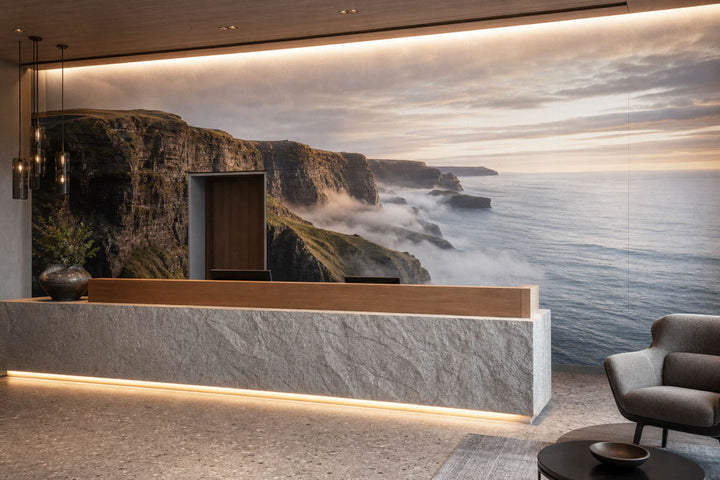
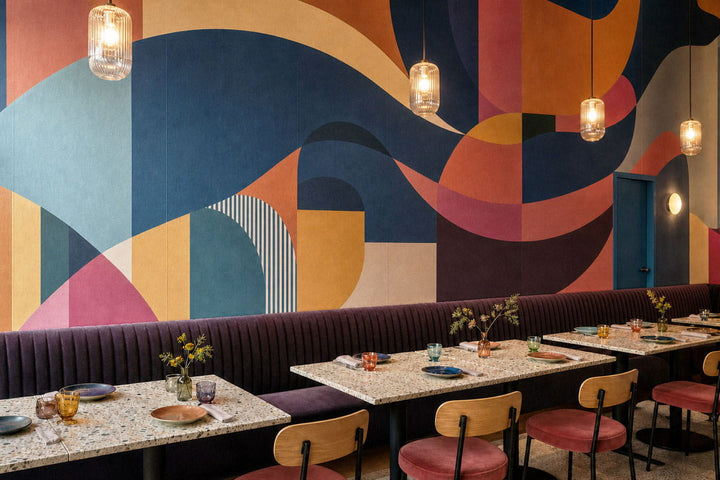
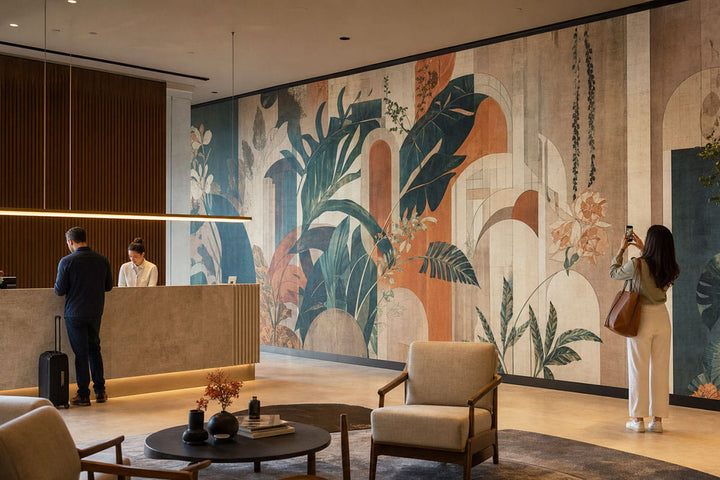
Wallpapered works across hotels and resorts, restaurants and cafes, corporate offices, and schools and universities - and each sector carries distinct requirements that a supplier working primarily in residential environments won't anticipate. The commercial wallpaper overview sets out what that process looks like before any commitment is made.
Is "Custom" Wallpaper Actually Custom?
Worth saying plainly: a large image printed onto a wall is not automatically a well-specified mural.
The custom wallpaper market has grown considerably, and a meaningful proportion of what's sold under that label is a stock library image resized to fit the ordered dimensions. The print quality might be excellent. The result is still generic, because the design logic was never specific to the space or the brand it's supposed to represent.
In hospitality particularly, there's been a clear movement among discerning operators away from adapted stock imagery toward original artwork, local photography, and design that's specific to the property. A restaurant using the same mural library as the venue next door has lost something it can't recover. The wall becomes part of the brand story - or it's wasted square footage.
This is where interior designers working on commercial briefs have a genuine opportunity to add measurable value. Specifying a wall design that responds to the architecture, reflects the brand, and can't be found in any supplier catalogue is a different proposition entirely from selecting a pattern in a larger format. For designers looking to structure that process professionally, the trade and interior designers page outlines how Wallpapered approaches these briefs - including how the design and specification process works as a collaboration.
When Custom Printed Wallpaper Isn't the Right Answer
It isn't right for every wall. Being clear about that matters.
If the requirement is purely functional - cover the wall cleanly, low design ambition, frequent repainting expected - standard paint or a pattern wallpaper will serve the purpose better and at lower cost. Custom work requires meaningful investment in design time, accurate measurement, and the correct substrate. Cut corners on any of those and the result reflects badly on everyone involved.
It's also poorly suited to environments that refresh their visual identity frequently. A retail space changing its look every few weeks isn't a strong candidate for a permanent installation. Removable peel-and-stick alternatives exist for that use case, and they carry their own tradeoffs worth understanding before ordering.
And it genuinely isn't worth doing on a wall that hasn't been properly prepared. Damp, uneven plaster, or a poorly treated surface will undermine even the best print. The wall has to be ready before the mural arrives.
Comparing Your Options: A Practical Reference
|
Approach |
Design Specificity |
Durability |
Typical Cost Range |
Best Suited For |
|
Custom printed wallpaper |
High - designed to the wall |
High with correct substrate |
Mid to High |
Feature walls, brand environments, hospitality |
|
Peel-and-stick wallpaper |
Medium |
Lower in high-traffic areas |
Low to Mid |
Temporary installs, rentals, testing |
|
Paint |
Low |
High |
Low |
Neutral backgrounds, frequent repaints |
|
Commissioned wall art |
Very high |
Varies by medium |
High to Very High |
Flagship spaces, one-off installations |
|
Standard pattern wallpaper |
Low |
Medium |
Low to Mid |
Consistent repeat pattern coverage |
Frequently Asked Questions
How do I choose the right paper type for a commercial environment?
Substrate selection comes down to three factors: the wall's physical environment, the level of daily traffic or physical contact, and whether the surface needs regular cleaning. A gym or kitchen wall needs a wipe-clean, moisture-resistant finish. A hotel bedroom corridor can carry a more textured substrate. Choosing based on appearance rather than use is the most common cause of premature wear in commercial installations.
Can custom wallpaper be printed to fit an irregular wall shape?
Yes - and this is one of the practical advantages over standard wallpaper. Walls with alcoves, sloped ceilings, chimney breasts, or unusual dimensions can be measured and printed to fit exactly. The key is accurate measurement before the design goes to print. Trying to resolve fit issues on installation day is slower, more expensive, and rarely produces a clean result.
How long should a commercial mural last?
With the correct substrate matched to the environment and professional installation on a properly prepared surface, a commercial mural should remain in sound condition for several years. The key variables are surface preparation, ambient humidity, and whether the paper type was genuinely suited to the use case. Print quality alone doesn't determine longevity - the condition of the wall beneath it does.
Is custom printed wallpaper suitable for a rented commercial space?
It depends on the lease terms and the landlord's consent. Permanent adhesive wallpaper generally requires explicit agreement before installation in a leased property. For short-term or flexible tenancies, removable alternatives are worth exploring, though they carry different durability and finish characteristics that should be understood before ordering.
What file resolution is needed for large-format printing?
For large-format output, designs typically need to be supplied at 150-300 DPI at the intended print size. Vector files scale without quality loss; raster images need to be checked at actual print dimensions before production. Submitting a file at screen resolution and assuming it'll hold up at two metres wide is the fastest route to a result that nobody wanted.
Can the same design be adapted across multiple rooms or sites?
Yes, and this is standard practice in hospitality and retail rollouts. A design is developed once and adapted to each wall's specific dimensions. The discipline required is measuring each wall independently - assuming all rooms in a building share identical proportions is a reliable way to end up with misaligned panels across every site.
How does the ordering process work for a commercial project?
Commercial projects typically begin with an initial consultation to establish the brief, followed by accurate measurement, design development or adaptation, substrate selection, and then production and delivery. The full process at Wallpapered is structured to handle multi-room and multi-site briefs, with specification decisions resolved before anything goes to print. That's where the outcome is actually determined - not on installation day.
The wall isn't a finishing touch. It's a structural decision that either earns its place in the room or quietly undermines everything around it. The designers and fit-out teams getting the strongest results from custom printed wallpaper are the ones who got the brief right before the first panel was ever printed.
If you're working on a commercial project that deserves a properly considered wall specification, get in touch with the Wallpapered team with your dimensions, environment details, and design intent - and build the specification from the wall out.