How Commercial Fit-Out Teams Justify Bespoke Wallpaper to Clients - and What Drives the Real Difference in Results

Commercial wall murals produce measurable results when they're specified around a clear purpose. When that purpose is missing from the brief, the result can turn into an expensive print that nobody engages with. The difference between the two outcomes is almost never the design itself - it's a decision made weeks before anyone opens a design file.
Key Takeaways
• Commercial murals that perform well are specified around a function - wayfinding, brand identity, dwell time, social activation - not decoration alone
• Weak results almost always trace back to the same root cause: the wall was treated as the last decision in a fit-out brief, not the first
• Custom-printed murals outperform generic alternatives in commercial settings because specificity is what makes them work
• Realistic ROI timelines differ by sector - hospitality and food and beverage see feedback fastest; corporate and education environments see slower but more durable returns
• The most important decision in any mural project happens before the design starts: giving the wall a brief of its own
Why Do So Many Commercial Wall Murals Fail to Earn Their Keep?
It's not the print quality. It's not the design palette. The root cause, almost every time, is a briefing process that treated the wall as an afterthought.
Here's how it typically unfolds. A commercial fit-out reaches its final stages. The furniture's been specified, the lighting plan's been signed off, the brand guidelines have been applied to every touchpoint you can name - and then someone notices forty square metres of empty plaster and asks what to put on it. At that point, the mural becomes filler. It's chosen to occupy space rather than to do anything particular in it.
A wall mural that hasn't been given a job to do is a wall mural that won't earn its keep.
That's not a design problem. It's a sequencing problem. And because the mural was never tied to a measurable outcome, there's no way to know if it worked - which means the next project makes exactly the same call.
What Does a Strong Commercial Result Actually Look Like?
Strong results follow a recognisable pattern. The mural was specified to do something specific, and that something was measurable.
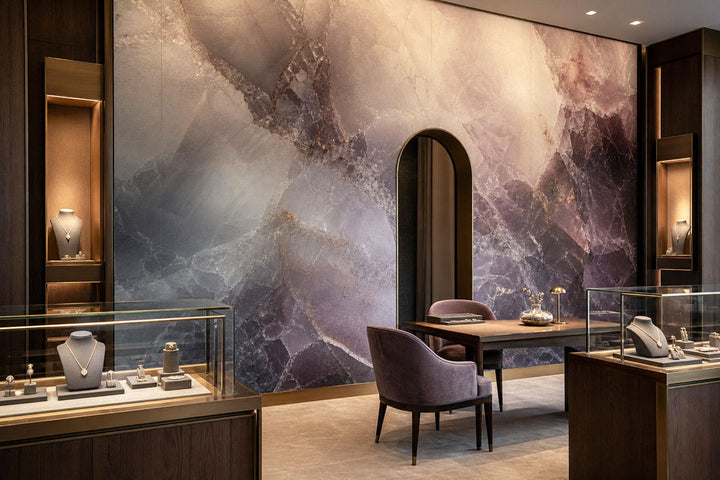
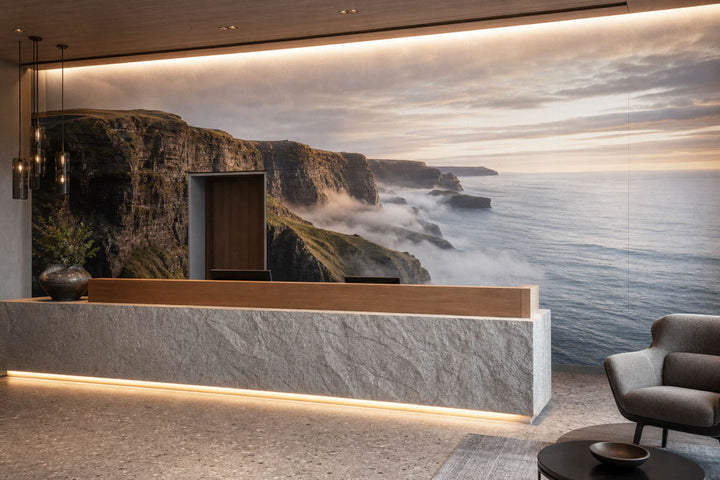
Consider a typical hotel lobby scenario. A large-format custom wallpaper mural anchoring the reception feature wall is specified with a clear purpose: shaping the guest's first impression of the space. The mechanism isn't complicated - the human brain assigns environmental quality to the most visually dominant surface in a room within seconds of entering. A striking, well-placed mural behind reception changes that first-impression calculus immediately. Hotel operators who apply this approach consistently find that guest review language around "atmosphere" and "character" shifts noticeably.
 In retail, the dynamic is different but equally substantial. A mural in a retail environment that creates a genuinely photogenic backdrop - one customers actually want to stand in front of - extends the commercial life of the installation well beyond the physical shop floor. Social sharing is unpaid reach. A well-positioned mural becomes a repeating asset that keeps appearing in feeds long after installation day.

For corporate offices, the return is less about footfall and more about identity and retention. Research from Leesman - whose Leesman Index is one of the most widely used employee workplace experience benchmarks - consistently shows that environments perceived to reflect organisational values correlate with higher reported employee engagement. A custom mural communicating a company's history, locations, or founding story does something a motivational print simply can't: it signals that the organisation invested meaningfully in the space, which signals it invests meaningfully in the people inside it.
The Four Conditions That Predict Whether a Mural Will Perform
Before any commercial mural project moves into design, it's worth running it against four diagnostic conditions. If fewer than three are met, the brief needs revisiting.
Condition one - Functional purpose. The mural has a defined job: wayfinding, brand storytelling, dwell-time extension, social media activation, or emotional recall. "It should look nice" isn't a functional purpose.
Condition two - Audience specificity. The design speaks to the actual people who'll stand in front of it - guests, customers, students, patients - not a generalised demographic. A school or university mural that references the institution's own history or geography lands completely differently to a stock landscape scene.
Condition three - Spatial dominance. The mural is the largest visual element in the space, not competing with a busy ceiling, feature bar, and three separate signage systems. A mural that has to fight for attention won't win.
Condition four - Print specification matched to viewing distance. A mural viewed at half a metre in a corridor needs a different resolution and finish to one viewed at five metres across a restaurant floor. Mismatched specification is the most common technical failure in commercial projects. The full range of paper types and finishes is where those technical decisions get made - it's worth working through before committing to a substrate.
Custom vs. Off-the-Shelf: The Honest Tradeoff
|
Factor |
Custom-Printed Mural |
Off-the-Shelf / Generic Mural |
|
Brand alignment |
Precise - designed to the brief |
Approximate at best |
|
Audience specificity |
High - location, identity, purpose built in |
Low - designed for no one in particular |
|
Reorder accuracy |
Exact match guaranteed |
Dye lots vary; matching is unreliable |
|
Lead time |
Longer - typically days to weeks |
Faster - stock items ship immediately |
|
Upfront cost |
Higher |
Lower |
|
Long-term commercial return |
Higher - tied to a specific function |
Lower - decorative only |
The off-the-shelf route wins on speed and upfront cost. That's its whole case.
For a temporary pop-up or a short-lease fit-out with a six-month horizon, that trade-off can make genuine sense. But for any installation where the wall is expected to do commercial work - in a hotel, a restaurant or café, a gym, a school - only the custom route can deliver against a functional brief. You can't brief a stock image.
The counterintuitive truth is that custom murals aren't a premium version of the same thing - they're a different category of decision entirely.
What Are the Honest Timelines for Seeing Results?
Timelines vary by sector and by what you're measuring.
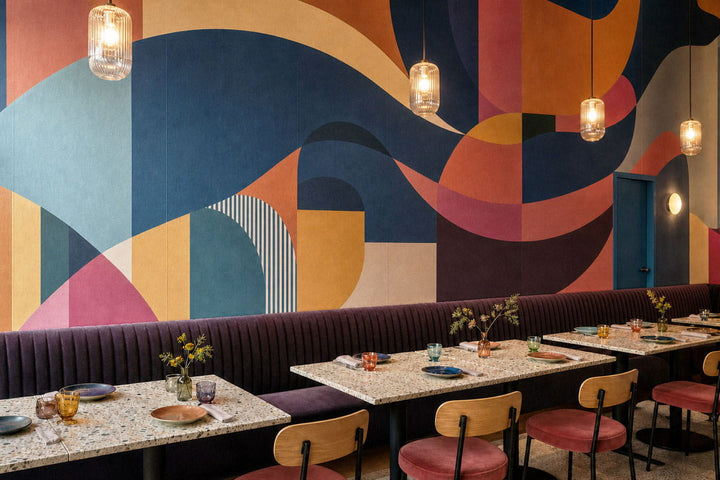
In hospitality and food and beverage, feedback arrives quickly. Guest reviews referencing the space, social posts tagged at the venue, and word-of-mouth referrals typically surface within weeks of installation. The mechanism is emotional: a distinctive space becomes a story worth telling, and people tell it straight away.
In corporate environments, the signal takes longer and arrives more softly. You're measuring engagement, client perception, and new-hire impressions - none of which show up in a week. Practitioners working in workplace design commonly report that the impact of environmental investment shows up most clearly in qualitative client feedback and in how candidates describe the office during recruitment conversations.
For estate agents using custom map wallpaper or branded wall graphics in branch offices, the return is largely perceptual. A large-format map of the agency's patch signals local expertise and permanence to every walk-in client from day one. That signal works immediately; its commercial effect compounds quietly over months.
When a Custom Mural Is the Wrong Call
This is worth being direct about. Custom wall murals don't work for every situation, and overselling the fit does nobody any favours.
If your lease is under twelve months and renewal isn't certain, the economics of a bespoke installation rarely stack up. A peel-and-stick alternative may be a better fit for short-term or rented environments where reversibility matters more than permanence.
If the brief is purely decorative - "something on the wall" with no defined audience and no function - a custom print is over-specified for the job. The investment case for custom is built entirely on specificity. Remove the specificity and the premium isn't justified.
And if the wall itself isn't ready - damp, uneven surface, poor lighting - no print will compensate. Surface preparation matters before anything else. The installation guide covers what to check before a project timeline gets agreed, and it's genuinely worth reading before any commitment is made.
Frequently Asked Questions
How long does a custom wall mural typically last in a commercial space?
With proper surface preparation and the right finish for the environment, a commercial-grade mural should perform well for several years in normal use. High-traffic areas - corridors, reception desks, children's spaces - benefit from a wipe-clean, premium finish. The substrate and finish choice made at specification stage determines longevity more than print quality does.
Can the design still work if the rest of the room gets updated?
It's a real risk worth thinking through at the brief stage. Murals closely tied to a specific brand colour palette or furniture scheme can look out of place when the surrounding interior is refreshed. Designs with strong graphic or illustrative qualities - maps, botanical prints, architectural line work - tend to age better than those matched tightly to a seasonal scheme.
Can irregular walls with doors and windows be accommodated?
Yes. Custom printing means the design is sized and cropped to exact wall dimensions, including any obstacles. Wallpapered produces murals to fit any wall configuration - the wall measurement guide explains how to take accurate measurements for walls with doors, windows, and sockets before ordering.
Is the ROI case stronger in some sectors than others?
Hospitality and food and beverage see the fastest return because the mechanism - social sharing, guest reviews, dwell time - operates in real time. Education and corporate environments see slower but more durable returns through identity and engagement. Retail sits in the middle: the return depends heavily on whether the mural creates a genuinely shareable moment or simply fills a wall.
What's the most common mistake commercial clients make when briefing a mural project?
Starting with the design before defining the purpose. "What should it look like?" should come after "what should it do?" and "who is it for?" Most weak results trace back to this sequence being reversed. A mural chosen for visual appeal alone rarely performs commercially because it wasn't built around a function.
How does custom map wallpaper work for estate agents and commercial offices?
Custom map wallpaper for estate agents is typically a large-format print of the agency's patch - the specific towns, streets, or regions the branch covers - produced at exact wall dimensions. It signals local knowledge immediately and gives walk-in clients an immediate talking point. For commercial offices, a custom map of company locations, supply chain routes, or key markets serves an equivalent identity function. Both are designed from your brief.
How does Wallpapered approach commercial projects differently from residential orders?
Commercial projects carry different requirements - multiple walls, phased installations, substrate choices suited to high-traffic conditions, and often coordination with fit-out contractors and site managers. The commercial wallpaper service is built around those requirements, with guidance on specification, finish selection, and installation sequencing for larger and more complex projects.
If you're specifying a commercial installation and want to work through the brief properly - purpose, audience, spatial context, and finish - the commercial enquiry page is the right starting point. Bring the wall dimensions and a clear sense of what the space needs to do. That's all it takes to get a project moving.
For residential projects or smaller commercial spaces, the how it works page walks through the full process from brief to delivery and installation.