Commercial Wallpaper Specification Guide for Interior Designers and Fit-Out Teams

Specifying custom wallpaper for a commercial project requires a different approach from choosing wallpaper for a residential room. Wall dimensions, surface condition, environmental demands, design intent and installation planning all need to be considered before artwork goes into production.
When those decisions are made in the right order, the mural feels considered as part of the interior rather than added at the end.
Key Takeaways
- Treat the wall as part of the design brief from the beginning, not as a finishing decision.
- Accurate measurements are essential because the artwork is prepared specifically for the wall dimensions.
- Wallpaper type should be selected according to the environment, durability requirements and expected level of cleaning.
- Commercial projects often involve more stakeholders, fixed installation dates and additional specification requirements.
- Resolve the surface, environment, audience and expected longevity before finalising the artwork.
- Custom printed wallpaper is not the right solution for every project. Knowing when another finish is more appropriate is part of good specification.
Why Do Commercial Wallpaper Projects Go Wrong?
Problems with commercial wallpaper often begin before anything is printed.
A wall may be measured too early in the project, before the finished dimensions are known. A wallpaper finish may be selected before the level of footfall or cleaning has been considered. Artwork may be approved without accounting for doors, furniture or other architectural features.
Individually, these can seem like small decisions. At mural scale, they can affect the entire installation.
A hotel reception, restaurant dining room, school corridor and corporate boardroom all place different demands on a wallcovering. The design may be equally important in each setting, but the specification behind it should respond to the way the space will actually be used.
The most reliable approach is therefore to start with the wall itself.
What Does a Reliable Commercial Wallpaper Specification Process Look Like?
A useful way to approach a bespoke mural is through a simple wall-first sequence.
Stage 1: Understand the Environment
Before choosing a wallpaper finish, establish the conditions the mural will experience.
Consider:
- humidity and moisture
- natural and artificial light
- level of footfall
- likelihood of physical contact
- cleaning requirements
- wall condition and surface preparation
A feature wall in a hotel bedroom has different requirements from a busy corridor, restaurant or reception area.
These practical factors should inform the material choice before production begins.
You can compare Wallpapered’s current wallpaper types to understand the available finishes.
Stage 2: Measure the Finished Wall
Accurate measurements are the foundation of a made-to-measure mural.
Measure the width and height at their widest and tallest points, and identify anything that interrupts the wall, including:
- doors
- windows
- sockets
- alcoves
- sloping ceilings
- radiators
- fitted furniture
- other fixed architectural features
The artwork can then be positioned with those elements in mind, helping important parts of the design remain visible once installed.
For more detailed guidance, see our How to Measure Your Wall guide.
For projects involving several rooms or sites, each wall should be measured individually rather than assuming apparently similar spaces share identical dimensions.
Stage 3: Define What the Wall Needs to Do
Before selecting artwork, decide what role the wall should play within the interior.
Is it intended to:
- create a focal point?
- communicate a brand identity?
- establish a sense of place?
- introduce colour or visual depth?
- support a customer or visitor experience?
- complement an existing interior scheme?
That purpose should guide the artwork rather than being decided after an image has already been selected.
A restaurant mural, for example, may need to reinforce the atmosphere of the dining space. A hotel mural might reference the local area. A corporate reception could incorporate brand artwork or imagery linked to the organisation.
When the objective is clear, decisions about imagery, crop, scale and positioning become much easier.
Stage 4: Confirm the Wallpaper Finish
Once the environment, wall and design intent are understood, the wallpaper finish can be selected.
The appropriate choice depends on the requirements of the space.
A lower-contact interior may have different needs from a busy hospitality, education or workplace environment where regular cleaning and durability are more important.
Material selection should therefore be treated as part of the specification rather than simply an aesthetic preference.

Four Questions to Resolve Before Finalising the Brief
Before artwork goes into production, make sure the project brief answers four practical questions.
Surface
What are the finished wall dimensions and condition?
Are there doors, windows, sockets, recesses, radiators or other architectural elements that need to be considered when positioning the artwork?
Environment
What conditions will the mural experience?
Consider humidity, light exposure, footfall, physical contact and how frequently the wall is likely to require cleaning.
Audience
Who uses the space, and what does the wall need to communicate to them?
A hotel guest, office visitor, restaurant customer and pupil will experience the space differently. The design should reflect the purpose of the environment.
Longevity
How long is the installation expected to remain in place?
A permanent hospitality refurbishment has different priorities from a short-term campaign, temporary retail installation or regularly refreshed interior.
Resolving these four points early helps align the artwork, wallpaper finish and installation approach before production begins.
How Is Commercial Specification Different from Residential?
The creative process can look similar, but commercial projects usually involve more variables.
A commercial brief may include:
- several decision-makers
- brand guidelines
- fixed refurbishment or installation dates
- higher levels of daily footfall
- regular cleaning requirements
- multiple walls or locations
- fire-performance or other project-specific documentation requirements
- professional installers or fit-out contractors
An interior designer may also be specifying the mural on behalf of a client rather than purchasing it for their own space.
That makes communication and approval stages particularly important.
Wallpapered works with interior designers, fit-out teams and businesses across hospitality, workplace, retail, education and other commercial interiors.
If you are specifying on behalf of a client, our Trade & Interior Designers service explains how we work with professional design projects.
For broader commercial enquiries, see our Commercial Wallpaper service.
What Makes Custom Wallpaper Truly Bespoke?
Printing an image at a large size does not automatically make it suitable for a particular wall.
A genuinely bespoke mural considers the relationship between the artwork and the space.
That may involve:
- scaling and positioning the artwork to the wall dimensions
- choosing an appropriate crop
- working around doors or architectural features
- adjusting colour to complement an interior scheme
- incorporating brand artwork or graphics
- preparing client-supplied photography or artwork
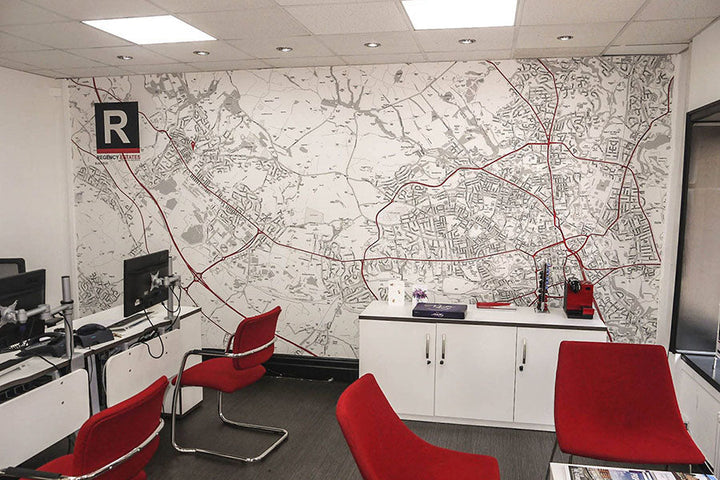
- creating a custom map around a particular location
- supplying a design proof for approval before production
This is where custom wallpaper differs most significantly from choosing a standard repeated wallpaper design.
The goal is not simply to cover the wall. It is to make the artwork feel as though it belongs there.
When Custom Printed Wallpaper Isn't the Right Answer
Custom murals are not appropriate for every wall.
If a space is being changed very frequently, a permanent made-to-measure installation may not offer enough value for the time it will remain in place.
If the wall has unresolved damp, unstable paint, significant surface damage or other preparation problems, those issues should be addressed before wallpaper is installed.
Likewise, if the project brief is still changing, it is usually better to resolve the design and dimensions before artwork enters production.
For shorter-term interiors or situations where a traditional paste-the-wall installation is unsuitable, a removable option may be worth considering.
The strongest custom mural projects tend to be those where the wall has a clear purpose and the specification has been resolved before printing begins.
Custom Wallpaper, Standard Wallpaper, Paint or Wall Art?
Each option has a different role.
Custom Wallpaper Murals
Best suited to spaces where the wall needs to carry a specific image, artwork, location or brand story.
The artwork can be prepared specifically for the dimensions and proportions of the wall.
Standard Pattern Wallpaper
Useful where repeated pattern, texture or colour is the main requirement.
It generally requires less artwork preparation because the design is intended to repeat across different wall sizes.
Paint
A practical choice where the wall mainly needs colour or a neutral background.
It can also make sense in spaces expected to be refreshed frequently.
Framed Artwork
Useful where the design needs to occupy a defined area rather than the whole wall.
Artwork can also be changed independently of the wall finish.
Peel-and-Stick Wallpaper
Can be useful where removability or a different installation method is important.
The suitability of any finish should still be considered in relation to the wall surface and environment.
Frequently Asked Questions
How do I choose the right paper type for a commercial environment?
Start with how the space will be used.
Consider humidity, daily footfall, physical contact and cleaning requirements before selecting the finish. The most visually appealing material is not necessarily the most appropriate for the environment.
Our wallpaper types page explains the current Wallpapered options.
Can custom wallpaper be printed to fit an irregular wall shape?
Yes - and this is one of the practical advantages over standard wallpaper. Walls with alcoves, sloped ceilings, chimney breasts, or unusual dimensions can be measured and printed to fit exactly. The key is accurate measurement before the design goes to print. Trying to resolve fit issues on installation day is slower, more expensive, and rarely produces a clean result.
Can I supply my own artwork or photography?
Yes.
Wallpapered can work with supplied artwork, photography and brand assets. The file needs to be suitable for printing at the required wall size, so our team can review the artwork before production.
Where adjustments are required, these can be discussed as part of the project.
How long should a commercial mural last?
With the correct substrate matched to the environment and professional installation on a properly prepared surface, a commercial mural should remain in sound condition for several years. The key variables are surface preparation, ambient humidity, and whether the paper type was genuinely suited to the use case. Print quality alone doesn't determine longevity - the condition of the wall beneath it does.
Is custom printed wallpaper suitable for a rented commercial space?
It depends on the lease terms and the landlord's consent. Permanent adhesive wallpaper generally requires explicit agreement before installation in a leased property. For short-term or flexible tenancies, removable alternatives are worth exploring, though they carry different durability and finish characteristics that should be understood before ordering.
What file resolution is needed for large-format printing?
For large-format output, designs typically need to be supplied at 120-300 DPI at the intended print size. Vector files scale without quality loss; raster images need to be checked at actual print dimensions before production. Submitting a file at screen resolution and assuming it'll hold up at two metres wide is the fastest route to a result that nobody wanted.
Can the same design be adapted across multiple rooms or sites?
Yes, and this is standard practice in hospitality and retail rollouts. A design is developed once and adapted to each wall's specific dimensions. The discipline required is measuring each wall independently - assuming all rooms in a building share identical proportions is a reliable way to end up with misaligned panels across every site.
How does the ordering process work for a commercial project?
Commercial projects typically begin with an initial consultation to establish the brief, followed by accurate measurement, design development or adaptation, substrate selection, and then production and delivery. The full process at Wallpapered is structured to handle multi-room and multi-site briefs, with specification decisions resolved before anything goes to print. That's where the outcome is actually determined - not on installation day.
Start With the Wall
A successful commercial mural is decided long before the first panel is installed.
The strongest projects begin with a clear understanding of the wall, the environment, the people using the space, and the job the design needs to do.
Resolve those elements first, and decisions about artwork, material, and installation become considerably clearer.
If you are planning a commercial wallpaper project, explore our Commercial Wallpaper service, visit our Trade & Interior Designers page, or contact the Wallpapered team to discuss your brief.